
A homeowner needs a painter, tree service, or renovation company. They search nearby, compare a few businesses, and decide whom to contact. Local SEO helps your company enter that decision with clear information and credible proof.
Start with the basics you can maintain consistently. A useful plan connects your business profile, service pages, project examples, and enquiry handling. Visibility becomes valuable when the right customer can understand your offer and reach your team.
1. Define the work and locations you actually serve
Write down the services you want more of, the places you genuinely cover, and the jobs you do not take. A painting company might prioritise interior repainting and cabinet refinishing within a realistic travel radius. That is more useful than trying to target every home improvement search.
Use that list to organise your website. Keep a distinction between a real business location and the towns your team visits. Do not invent offices or addresses to make your coverage appear bigger. Explain any limits that affect whether a customer should enquire.
Choose a small set of priority services first. Give each one a useful page and a way to measure enquiries. Expanding before your core information is accurate makes maintenance harder and produces a confusing customer experience.
2. Check your Google Business Profile
Review your business name, category, phone number, website, hours, and services. Represent the real business instead of adding search keywords to its name. Keep exceptional opening hours current, and check that someone answers the listed number.
Google describes local ranking through relevance, distance, and prominence. Accurate information helps explain what your company offers, but you cannot promise a particular position everywhere. Read Google’s local ranking guidance for the underlying explanation.
Treat the profile as a customer resource. Use current photographs that accurately represent your business. Confirm that the website link leads to a useful destination. A customer should not have to guess whether an old offer, photograph, or opening time still applies.
3. Make service pages answer buying questions
A useful service page explains the job, who it suits, how the process works, and what affects the estimate. For cabinet painting, customers may need to understand preparation, finish options, access requirements, and the sequence of work. Address those questions before repeating your town name.
Explain what your team needs before quoting. If an inspection is necessary, say why. If certain work is outside your scope, make that clear too. A page that filters unsuitable enquiries can be more useful than one that promises everything to everyone.
Use a clear next step that matches the service. The customer should know whether they are requesting a call, arranging a site visit, or submitting information for an initial estimate. Keep that expectation consistent with how your office actually works.
4. Add genuine project evidence
A project story can show how your team approaches a job. Describe the starting condition, the customer’s needs, the work performed, and any practical constraints. Use photographs with permission and avoid presenting stock imagery as a completed customer project.
Specific explanations are more useful than unsupported claims about being the best. For example, a painting company can explain how it protected an occupied room or prepared damaged surfaces. These details help customers evaluate your approach without invented statistics or exaggerated promises.
If you create location pages, include information that makes each page worthwhile. Relevant projects and genuine coverage details are useful. A set of identical pages with different city names gives readers little help when deciding whether to contact you.
5. Connect reviews with the customer journey
Place relevant feedback near the service it supports. A review about a kitchen repaint is helpful on a cabinet painting page. Keep testimonials accurate, and do not add details the customer did not provide.
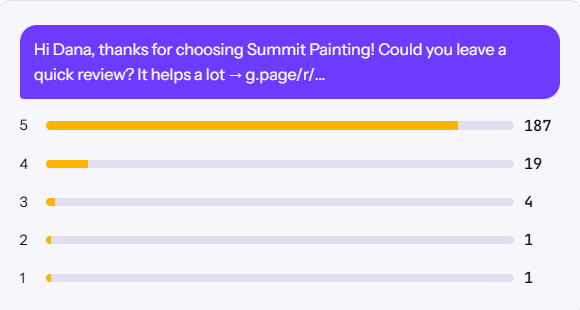
Ask for honest reviews without influencing the rating. Our guide to building a consistent Google review process explains a practical workflow. Make the process simple enough that your team can follow it during a busy week.
Then test the journey on a phone. Can someone read the service page, open the menu, call the business, and submit a request? Accurate listings cannot compensate for a broken form or unanswered calls. Local visibility and the enquiry experience need attention together.
6. Measure qualified enquiries
Define a useful lead before discussing results. Record the requested service, location, source when known, and whether the enquiry becomes an estimate or booked job. This separates relevant demand from traffic that never suited your business.
Review website and business profile performance alongside those enquiry records. Look for patterns rather than reacting to a single search from one device. Results depend on context, and one screenshot does not describe your whole market.
Let the findings guide the next improvement. If a service page attracts visitors but few suitable requests, investigate its explanation and contact route. If enquiries repeatedly come from outside your area, review how you describe coverage. Keep notes about changes so you can discuss progress with useful context.
A manageable first-month plan
During the first week, correct your business information and test contact routes. In week two, improve one important service page. In week three, add a genuine project example and standardise review requests. In week four, review enquiry quality and identify the next obstacle.
Read our contractor website checklist and AI search visibility guide to connect the work. If you want help building a realistic plan around your business, book an introductory call with The Largely.